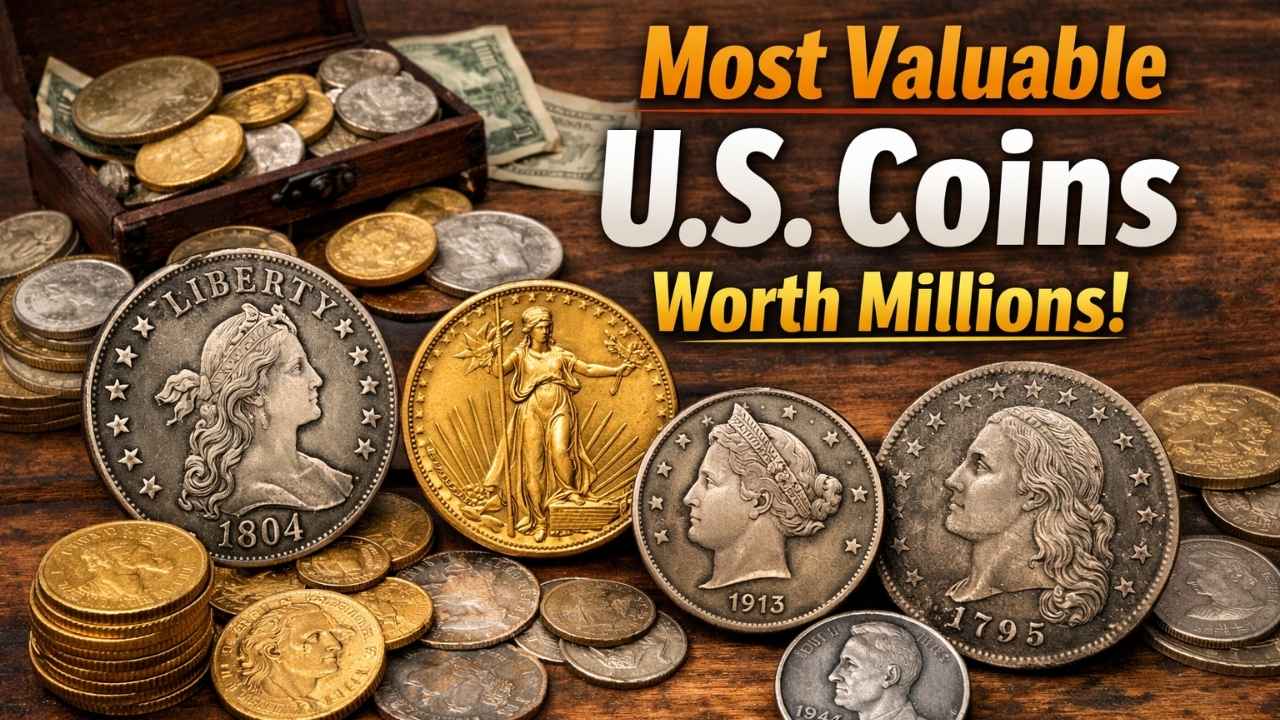
Top 10 Most Valuable U.S. Coins Worth Millions: Rare American coins hold a unique place in the world of collectibles. They are small pieces of metal, yet they carry stories of power, politics, economic change, and artistic ambition. Some were minted in extremely small numbers. Others survived melting orders, secret production, or historical turning points. Today, a handful of these coins are worth millions of dollars and are considered the crown jewels of American numismatics.
The fascination with rare coins began shortly after the establishment of the United States Mint in 1792. From the earliest silver dollars to the gold coins of the early twentieth century, certain issues have become legendary because of rarity, condition, and historical significance. Wealthy collectors compete fiercely for ownership, pushing auction prices to record-breaking levels.

Below is a carefully researched and originally written guide to the top 10 most valuable U.S. coins worth millions.
Quick Overview of the Top 10 Most Valuable U.S. Coins
| Rank | Coin | Year | Approximate Record Value | Why It Is Valuable |
|---|---|---|---|---|
| 1 | 1933 Double Eagle | 1933 | 18 million dollars plus | Gold recall survivor |
| 2 | 1794 Flowing Hair Silver Dollar | 1794 | 10 million dollars plus | First U.S. silver dollar |
| 3 | 1787 Brasher Doubloon | 1787 | 9 million dollars plus | Early private gold issue |
| 4 | 1804 Silver Dollar | 1804 | 7 million dollars plus | Diplomatic rarity |
| 5 | 1913 Liberty Head Nickel | 1913 | 4 million dollars plus | Only five known |
| 6 | 1907 Ultra High Relief Double Eagle | 1907 | 3 million dollars plus | Iconic artistic design |
| 7 | 1894 S Barber Dime | 1894 | 2 million dollars plus | Extremely limited mintage |
| 8 | 1861 Paquet Reverse Double Eagle | 1861 | 1.5 million dollars plus | Short-lived reverse design |
| 9 | 1796 Draped Bust Quarter | 1796 | 1.5 million dollars plus | First U.S. quarter |
| 10 | 1870 S Seated Liberty Dollar | 1870 | 1 million dollars plus | Mystery branch mint issue |
1933 Double Eagle
The 1933 Double Eagle is widely considered the most valuable American coin ever sold. Although more than four hundred thousand were struck, almost all were melted after President Franklin D. Roosevelt ended the circulation of gold during the Great Depression. Private ownership of gold coins became restricted, and surviving pieces were ordered destroyed.
A small number escaped melting. After years of legal battles, one example was legally sold at auction for more than 18 million dollars. That record-setting sale was handled by Sotheby’s in New York City.
This coin represents more than rarity. It symbolizes a dramatic shift in American monetary policy and remains the ultimate prize for elite collectors.
1794 Flowing Hair Silver Dollar
The 1794 Flowing Hair Silver Dollar is believed by many experts to be the first silver dollar struck by the United States government. It reflects the ambitions of a young nation seeking financial credibility on the global stage.
Featuring Lady Liberty with flowing hair on the obverse and an eagle on the reverse, the coin embodies early American ideals of freedom and strength. One exceptional specimen sold for over 10 million dollars, partly because it may have been among the very first examples produced.
Its historical importance combined with extreme rarity makes it one of the most sought-after coins in existence.
1787 Brasher Doubloon
Before the federal minting system was fully established, goldsmith Ephraim Brasher created gold coins known as Brasher Doubloons. Brasher was a respected craftsman and a neighbor of George Washington in New York City.
These gold coins were privately struck and are considered some of the earliest examples of American gold coinage. Only a handful exist today. One specimen sold for more than 9 million dollars, confirming its place among the most valuable coins in the world.
Collectors value it not only for its gold content but also for its connection to the earliest days of American independence.
1804 Silver Dollar
Often called the King of American Coins, the 1804 Silver Dollar was not actually minted in 1804. Most examples were produced decades later as diplomatic presentation pieces. They were included in special proof sets given to foreign dignitaries.
Only fifteen examples are known today, divided into different classes based on when they were struck. Because of their rarity and fascinating background, these coins regularly sell for millions when offered publicly.
The 1804 Silver Dollar is admired for its combination of mystery, prestige, and limited availability.
1913 Liberty Head Nickel
The 1913 Liberty Head Nickel is surrounded by intrigue. Official records indicate that Liberty Head nickels were discontinued before 1913. Yet five examples somehow appeared.
It is widely believed that the coins were secretly struck by a mint employee. Each of the five known specimens has been carefully documented over the years. One example resides in the Smithsonian Institution in Washington, D.C..
When one surfaces at auction, it easily commands more than 4 million dollars. Its rarity and mysterious origin make it legendary among collectors.
1907 Ultra High Relief Double Eagle
In 1907, sculptor Augustus Saint-Gaudens redesigned the Double Eagle gold coin. The Ultra High Relief version is considered one of the most beautiful coins ever produced in the United States.
The design required multiple strikes to bring out its dramatic depth, making mass production impractical. As a result, very few were made in this format.
Because of its artistic brilliance and limited production, top examples have sold for more than 3 million dollars. Many collectors view it as the pinnacle of American coin design.
1894 S Barber Dime
The 1894 S Barber Dime is one of the rarest small-denomination coins ever minted. Only 24 were produced at the San Francisco Mint, and fewer than 10 are known to survive today.
Why so few were struck remains uncertain. Some believe they were produced for bookkeeping adjustments. Others think they were special presentation pieces.
Whatever the reason, collectors eagerly pursue any surviving example. High-grade specimens have exceeded 2 million dollars at auction.
1861 Paquet Reverse Double Eagle
The 1861 Paquet Reverse Double Eagle features a modified reverse design created by Anthony Paquet. The lettering style was altered, but concerns about striking quality led to the design being quickly discontinued.
Only a limited number from the Philadelphia Mint are known today. Because of its short production run and distinct appearance, collectors prize it highly.
Examples in strong condition have achieved prices above 1.5 million dollars.
1796 Draped Bust Quarter
The 1796 Draped Bust Quarter was the first quarter-dollar coin issued by the United States. With a mintage of just over six thousand pieces, it is extremely scarce, especially in higher grades.
The design reflects the classical artistic influences popular in the late eighteenth century. For collectors building early American type sets, this coin is essential.
Well-preserved examples have crossed the 1.5 million dollar mark, demonstrating its enduring appeal.
1870 S Seated Liberty Dollar
The 1870 S Seated Liberty Dollar is one of the most mysterious coins in American history. Mint records do not clearly explain its production, yet a few specimens exist.
It is believed that fewer than a dozen survive. The uncertainty surrounding its origin adds to its allure.
When one appears at auction, it typically sells for over 1 million dollars, making it one of the rarest branch mint silver dollars ever produced.
Why These Coins Command Millions
Several factors determine why certain coins reach extraordinary prices.
Rarity is the most important factor. Coins with extremely low surviving populations naturally attract intense competition.
Historical context also matters. Coins connected to major events such as the Great Depression or early American independence carry emotional significance.
Condition plays a critical role. Coins graded at the highest levels by professional services can be worth many times more than lower-grade examples.
Provenance adds another layer of value. A coin once owned by a famous collector often commands premium bids.
The Investment Perspective
Rare coins have increasingly drawn interest from investors seeking tangible assets. Unlike paper currency or digital holdings, rare coins combine intrinsic metal value with historical importance.
However, investing in multi-million-dollar coins requires expertise, authentication, secure storage, and proper insurance. The market can be competitive and requires deep knowledge.
For serious collectors, these coins are not simply investments. They are historical masterpieces preserved for future generations.
Final Thoughts
The top 10 most valuable U.S. coins worth millions represent the highest level of rarity, beauty, and historical importance in American numismatics. From the dramatic survival story of the 1933 Double Eagle to the mysterious origins of the 1913 Liberty Head Nickel, each coin tells a powerful story.
Their values continue to rise as global demand for rare collectibles grows. These coins are more than metal. They are living pieces of American history, treasured by collectors and admired by historians around the world.