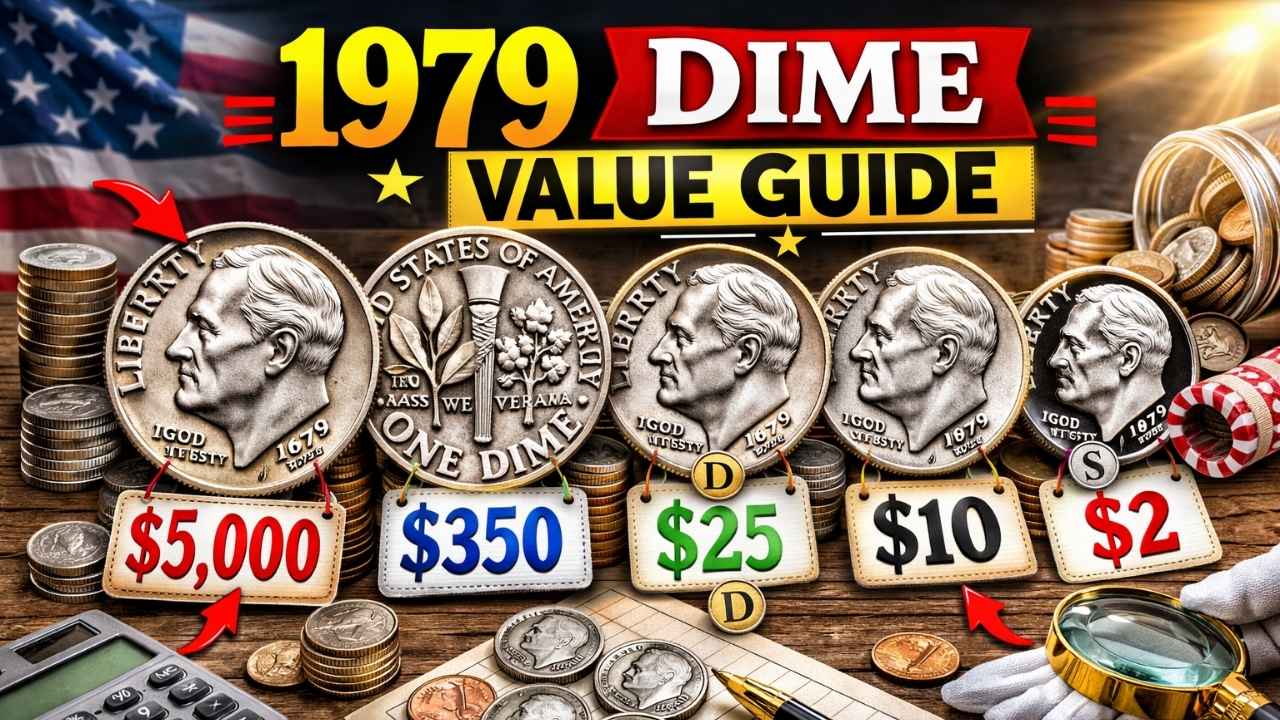
Rare 1979 Dime Value Guide: The 1979 dime, part of the Roosevelt dime series, is a coin that continues to intrigue collectors and enthusiasts. First introduced in 1946 to honor President Franklin D. Roosevelt, the dime has remained a staple of American currency. By 1979, the coin had already been in circulation for more than three decades, yet certain varieties and conditions from this year have gained special attention in the numismatic community.
Common Features of the 1979 Dime
The 1979 dime features Roosevelt’s profile on the obverse, designed by John R. Sinnock. The reverse shows a torch flanked by an olive branch and an oak branch, symbolizing liberty, peace, and strength. Most dimes from this year were struck in copper-nickel clad composition, which was standard for circulating coins. While millions were minted, not all are equal in value today.
Mint Marks and Their Importance
Mint marks play a crucial role in determining the rarity and value of a coin. In 1979, dimes were produced at three different mints:
- Philadelphia (no mint mark): These are the most common and generally hold minimal premium unless in pristine condition.
- Denver (D mint mark): Also widely circulated, but certain high-grade examples can be worth more.
- San Francisco (S mint mark): These were proof coins, often struck with higher detail and intended for collectors. Some varieties of the 1979-S proof dime are especially valuable.
The Special Case of the 1979-S Proof Dime
The San Francisco Mint produced proof dimes in 1979 with two distinct varieties of the “S” mint mark. Collectors differentiate between the Type 1 and Type 2 mint marks:
- Type 1: Features a filled “S” that appears less sharp.
- Type 2: Displays a clearer, more defined “S” and is considered scarcer.
The Type 2 proof dime is particularly sought after, with values significantly higher than its Type 1 counterpart. This distinction makes the 1979-S proof dime one of the most interesting coins of the year.
Condition and Grading
Like all coins, the condition of a 1979 dime greatly influences its market worth. Coins are graded on a scale from Poor (P-1) to Mint State (MS-70). Factors such as luster, strike quality, and absence of wear determine the grade. A 1979 dime in average circulated condition may only be worth face value, but one in uncirculated or proof condition can command much higher prices.

Market Demand Among Collectors
Collectors often seek out 1979 dimes for several reasons:
- Historical significance: As part of the long-running Roosevelt dime series, these coins represent continuity in U.S. coinage.
- Variety hunting: The differences between Type 1 and Type 2 proof dimes make them appealing for variety collectors.
- Investment potential: Rare and high-grade examples can appreciate in value over time, especially as demand grows.
Auction Records and Notable Sales
While most 1979 dimes are not worth more than a few dollars, certain examples have achieved impressive prices at auction. High-grade proof coins, particularly the Type 2 variety, have sold for hundreds of dollars. Exceptional specimens with perfect grading can reach even higher values, reflecting the strong demand among serious collectors.
How to Identify Valuable 1979 Dimes
If you suspect you have a valuable 1979 dime, here are steps to follow:
- Check the mint mark: Look for “D” or “S” below the date. Proof coins with the “S” mint mark are especially important.
- Examine the condition: Coins with sharp details and no wear are more valuable.
- Look for proof characteristics: Mirror-like surfaces and sharp strikes indicate proof coins.
- Seek professional grading: Submitting your coin to a grading service can provide an official assessment and increase its marketability.
The Role of Numismatics in Preserving History
Beyond monetary value, coins like the 1979 dime serve as historical artifacts. They reflect the economic, political, and cultural context of their time. Collectors not only invest in coins but also preserve pieces of history for future generations. The Roosevelt dime, with its enduring design, continues to symbolize leadership and resilience.

Conclusion
The 1979 dime may seem ordinary at first glance, but its variations and conditions make it a fascinating subject for collectors. While most examples are worth only their face value, certain proof varieties and high-grade specimens can command significant premiums. Whether you are a seasoned numismatist or someone curious about the change in your pocket, understanding the nuances of the 1979 dime adds depth to the appreciation of American coinage. Next time you come across one, take a closer look—it might be more than just ten cents.