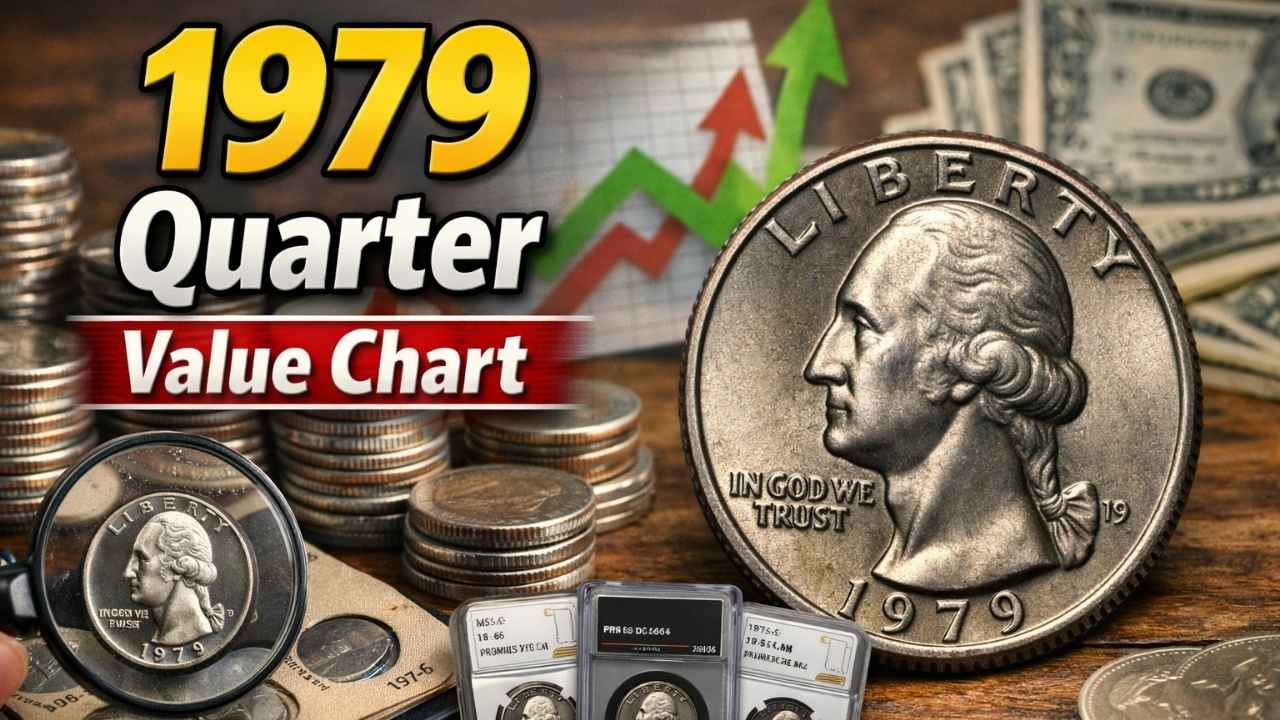
1979 Quarter Value Chart: The 1979 quarter is a familiar coin to most Americans, yet many collectors are surprised to learn that certain versions can carry premiums far beyond their face value. As part of the long running Washington design, this coin represents both everyday commerce and a potential treasure hiding in plain sight. While millions were produced, a small percentage stand out because of condition, mint marks, and minting errors.
Understanding the true value of a 1979 quarter requires looking beyond the date. Mint location, strike quality, and rare mistakes all influence how much collectors are willing to pay. In this detailed guide, you will find a complete value chart, explanations of rare mint marks, insight into error coins, and practical advice for identifying valuable pieces in your own collection.
Historical Background of the Washington Quarter
The Washington quarter was first introduced in 1932 to commemorate the 200th anniversary of the birth of George Washington. What began as a one year commemorative issue quickly became a permanent design in United States coinage.
By 1979, the design had already been circulating for decades. The obverse features the familiar portrait of Washington, while the reverse displays the eagle design that remained in use until the State Quarters program began in 1999. The coins minted in 1979 were struck in a copper nickel clad composition, as silver had been removed from circulating quarters in 1965.
The coins were produced by the United States Mint at three primary facilities during that year. Each facility left its own mint mark, which plays a crucial role in determining collector value.
Mint Marks on 1979 Quarters
Mint marks identify where a coin was struck. In 1979, quarters were produced at three major mint locations.
Coins without a mint mark were struck in Philadelphia. These are often called P mint coins, even though Philadelphia coins from that period did not display the P mint mark.
Coins with a D mint mark were struck in Denver.
Coins with an S mint mark were struck in San Francisco. These were typically proof coins made specifically for collectors.
Each mint produced different quantities and quality levels, which significantly affects the value of surviving examples today.

1979 Quarter Value Chart
Below is a general value chart for 1979 quarters. Values reflect approximate retail prices for coins in different conditions. Actual prices may vary depending on market demand and coin grading.
| Mint Mark | Circulated Condition | MS63 | MS65 | MS67 | Proof PR65 | Proof PR69 |
|---|---|---|---|---|---|---|
| No Mint Mark | $0.25 to $0.50 | $5 | $12 | $150 and up | N/A | N/A |
| D | $0.25 to $0.50 | $5 | $10 | $120 and up | N/A | N/A |
| S Proof | N/A | N/A | N/A | N/A | $3 to $5 | $15 to $40 |
| S Type 2 Proof | N/A | N/A | N/A | N/A | $10 to $20 | $75 and up |
Coins graded MS67 or higher can command strong premiums because very few survive in near perfect condition. Proof coins with deep cameo contrast may also bring higher prices than standard proof examples.
1979 No Mint Mark Quarter Value
Philadelphia struck hundreds of millions of quarters in 1979. Because of this high mintage, most examples found in circulation are worth only face value.
However, condition is everything. Coins that never entered circulation and remain in mint state can be worth significantly more. An MS65 example may bring around ten dollars, while a sharply struck MS67 coin can reach into the hundreds at auction.
Collectors pay special attention to coins with strong luster, minimal contact marks, and clean fields. Finding a top grade example from pocket change is rare but not impossible.
1979 D Quarter Value
The Denver Mint also produced a large number of quarters in 1979. Circulated examples are common and typically worth face value.
In mint state, values rise modestly. MS63 and MS65 examples are affordable for most collectors. High end pieces graded MS67 or above are far scarcer and can sell for over one hundred dollars.
Strike quality from Denver in 1979 was generally decent, but fully detailed examples with minimal abrasions are difficult to locate. This scarcity in top condition explains the premium prices.
1979 S Proof Quarter Value
San Francisco produced proof quarters for collectors in 1979. Proof coins are struck using specially prepared dies and polished planchets, resulting in sharp details and mirror like surfaces.
Most 1979 S proof quarters are relatively affordable. Lower grade proof examples often sell for just a few dollars. Coins graded PR69 with strong eye appeal may command higher prices, particularly if they display deep cameo contrast between the frosted design and mirrored background.
Because proof coins were sold directly to collectors and stored carefully, many survive in high grades. This keeps prices reasonable for most examples.
1979 S Type 2 Proof Quarter
One of the most interesting varieties from 1979 is the Type 2 S proof quarter. The difference lies in the shape of the S mint mark.
On Type 1 proofs, the S mint mark appears filled or blob like. On Type 2 proofs, the S is clearer and more sharply defined. Collectors prize the Type 2 variety because it is much scarcer.
Even in moderate proof grades, Type 2 quarters can sell for several times the price of a standard proof. High grade examples with excellent eye appeal may reach significant premiums at auction.
Careful examination under magnification is necessary to distinguish between the two types. The difference is subtle but clear once you know what to look for.
Rare 1979 Quarter Error Coins
Error coins are among the most exciting finds for collectors. While standard 1979 quarters are common, error examples can be surprisingly valuable.
Some of the most sought after 1979 quarter errors include:
Double die errors
Off center strikes
Broadstrike errors
Clipped planchets
Struck through errors
Wrong planchet errors
Each type of error has its own characteristics and value range.
Double Die Errors
A double die error occurs when the coin die receives multiple misaligned impressions during manufacturing. This results in visible doubling on the finished coin.
On a 1979 quarter, doubling may appear on the lettering, date, or Washington’s profile. Strong examples with clear separation in the letters can bring substantial premiums.
Minor doubling that requires magnification to see may add modest value. Dramatic, easily visible doubling can raise a coin’s worth to one hundred dollars or more, depending on condition and demand.
Off Center Strikes
Off center errors happen when the planchet is not properly aligned during striking. Part of the design may be missing, and a blank crescent shape appears on one side.
The value depends on how far off center the strike is and whether the date is still visible. A 10 percent off center coin with a visible date may sell for thirty to fifty dollars. More dramatic examples can bring higher prices.
Collectors prefer pieces where the date is fully readable, as this confirms the year of issue.
Broadstrike Errors
A broadstrike occurs when the retaining collar fails during striking. The coin spreads outward, resulting in a larger diameter and no reeded edge.
Broadstrike 1979 quarters can sell for twenty five to seventy five dollars, depending on condition. Crisp examples with strong details are more desirable.
Clipped Planchet Errors
Clipped planchets are created when the metal strip used to make blanks overlaps improperly during punching. This results in a curved missing section on the finished coin.
A genuine clipped planchet will show a smooth curved clip and may display a weak strike opposite the clip due to metal flow.
Values typically range from twenty dollars to over one hundred dollars for dramatic examples in high grade.
Struck Through Errors
Struck through errors occur when a foreign object such as grease or debris is between the die and the planchet during striking. This creates an impression or missing detail in the design.
Minor struck through errors may add small premiums. More dramatic impressions can command higher prices, especially if the object left a distinct pattern.
Wrong Planchet Errors
One of the rarest and most valuable error types is the wrong planchet strike. This happens when a quarter design is struck on a blank intended for another denomination.
For example, if a 1979 quarter were struck on a nickel planchet, the coin would appear smaller and lighter than normal. These dramatic errors are highly collectible and can sell for hundreds or even thousands of dollars.
Authentication by a professional grading service is essential for such pieces.
Factors That Influence 1979 Quarter Value
Several factors determine how much a 1979 quarter is worth.
Condition
Mint mark
Rarity of the variety
Eye appeal
Market demand
Condition is usually the most important factor. Even common coins become valuable in top grades. Professional grading services assign numerical grades that heavily influence market value.
Rarity also plays a major role. A scarce Type 2 proof or a dramatic mint error will almost always be worth more than a standard issue coin in the same condition.
Eye appeal matters as well. Coins with attractive toning or strong luster often command higher prices than dull or heavily marked examples.
How to Identify a Valuable 1979 Quarter
Start by examining the mint mark. Look carefully near Washington’s ponytail on the obverse side of the coin.
Next, evaluate the condition. Check for wear on Washington’s hair and cheek. In mint state coins, these high points should show no flattening.
Use magnification to search for doubling in the lettering and date. Inspect the edges and surfaces for unusual features that might indicate an error.
Weighing the coin can also help identify wrong planchet errors. A standard clad quarter should weigh approximately 5.67 grams.
If you suspect you have a rare variety or error, consider having the coin authenticated and graded by a reputable third party service.
Are 1979 Quarters Made of Silver
Regular circulation 1979 quarters are not made of silver. They are composed of a copper core with outer layers of copper nickel.
However, special silver proof sets were produced for collectors in some years during the 1970s. Standard 1979 proof quarters were clad, not silver.
Always verify composition carefully before assuming a coin contains precious metal.
Investment Potential of 1979 Quarters
Most 1979 quarters will never be worth more than face value. However, select high grade mint state coins, scarce proof varieties, and dramatic errors can appreciate over time.
Collectors who focus on top population coins graded MS67 or higher often see stronger long term performance. Error coin collectors also drive demand for unusual pieces.
While not every coin will become a windfall, careful selection and knowledge of the market can lead to rewarding finds.
Final Thoughts on the 1979 Quarter Value Chart
The 1979 quarter may seem ordinary at first glance, but hidden within this common date are varieties and errors that excite collectors. From high grade Philadelphia and Denver mint state coins to scarce Type 2 proof quarters and dramatic mint errors, opportunities exist for both beginners and advanced numismatists.
By studying mint marks, understanding grading standards, and learning to identify genuine errors, you increase your chances of discovering a valuable coin in your collection.
The next time you come across a 1979 quarter, take a closer look. What appears to be simple pocket change could turn out to be a collectible piece worth far more than twenty five cents.